Golconda Diamonds Debut Appearance!
Diamonds from the Golconda mines occupy a legendary position in the history of gemstones. Revered for their exceptional purity, soft brilliance, and historical associations with royalty, Golconda diamonds have long been linked to the Mughal emperors and the Nizams of Hyderabad. Yet, from time to time, previously unheard-of Golconda diamonds surface through online reports, academic discussions, or high-profile auctions. These appearances often raise curiosity and debate, particularly when little or no historical documentation accompanies the stones. Understanding why this occurs requires an appreciation of history, politics, and the nature of record keeping during the eras in which these diamonds were mined and traded. The diamond professionals at Kaisilver, file this report explaining intriguings facts related to diamonds from the Golconda diamond mines. While you are welcome to send any queries related to gemstones and jewelry, to our team at sales@kaisilver.com We would like to confirm that, Kaisilver does not deal in Golconda diamonds. The information provided in this report related to diamonds from the Golconda region, has been compiled with the objective of sharing knowledge.
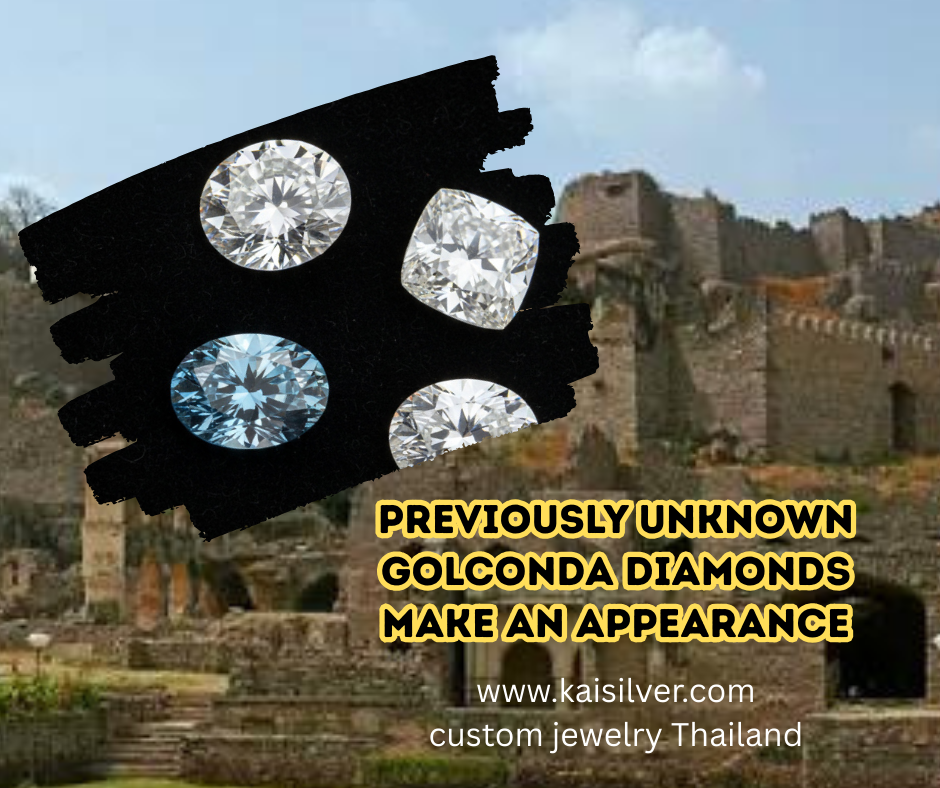
FAMED GOLCONDA MINES
The Golconda region, located in present-day Telangana, was once the world’s most important diamond-producing area. From the 16th to the 18th century, the mines of Golconda supplied diamonds of extraordinary quality, including some of the most famous stones known today. During this period, diamonds were not merely luxury objects; they were symbols of divine authority, political power, and wealth. The Mughal emperors, followed later by the Nizams of Hyderabad, exercised tight control over diamond mining and trade. In theory, most notable diamonds were supposed to pass through royal treasuries, where they would be catalogued, valued, and sometimes described in court chronicles. Kaisilver adds that, the best diamond pieces invariably entered the treasury of the rulers.
WEAK RECORD KEEPING
An interesting observation about the strict control maintained by Mughals and Nizams (during their respective times), over the Golconda mines and the diamond trade in their region - the rulers left loopholes in the record keeping process. Pilfrerage and misplacement, were common occurences. Historical documentation was far from comprehensive. Record keeping during the Mughal and early Nizam periods was inconsistent and often selective. Only diamonds deemed exceptional, politically significant, or ceremonially important were carefully stored. Smaller yet still remarkable stones could change hands without detailed mention, particularly if they were gifted to courtiers, foreign dignitaries, military commanders, or trusted allies. Over centuries, this created significant gaps in the historical record. As a result, it is entirely plausible that some Golconda diamonds exited royal treasuries without leaving a paper trail.
Political upheaval further contributed to this situation. The decline of the Mughal Empire, regional conflicts, colonial expansion, and eventually British intervention all destabilized traditional systems of control. During periods of invasion, rebellion, or administrative collapse, treasuries were looted, dispersed, or quietly emptied. Diamonds, due to their compact size and immense value, were particularly easy to conceal and transport. Some may have been carried abroad by merchants, soldiers, diplomats, or colonial officials, entering private collections in Europe or elsewhere. In such cases, the diamonds’ origins might have been remembered only orally or not at all. As the leading online custom made jewelry provider, Kaisilver considers accurate record keeping to be extremely important. In the case of the rulers of the Golconda region, weak record keeping could result in losses including thefts. The problem is that, voluntary gifting, sales, theft and misplacement, could not be separately identified.
GOLCONDA DIAMONDS MAKE SURPRISE APPEARANCE
This historical context helps explain why previously unknown Golconda diamonds occasionally emerge centuries later. Many have likely resided quietly in private collections, passed down through families, locked away in vaults, or incorporated into jewelry whose provenance was gradually forgotten. In the modern era, heightened global interest in Golconda diamonds has encouraged collectors and heirs to reexamine such stones. Advances in gemological testing now make it possible to identify characteristics associated with Golconda origin, such as exceptional chemical purity and specific structural traits. When a diamond is reassessed and tentatively linked to Golconda, it naturally attracts attention.
Important: Kaisilver has a strong word of caution here - whether it is a Golconda origin or a claimed link to royalty of the past, there is absolutely no assurance unless, the origin and related story, are certified by a reputed testing lab. While we mention this in this report related to Golconda diamonds, it is relevant for all gems, diamonds and jewelry. As our experts would put it, you cannot pay a premium price for an asset that, cannot prove its prominent status or features.
The role of high-profile auctions is particularly significant in bringing these diamonds to public awareness. Auction houses provide a global platform where rare and important gemstones are scrutinized by experts, collectors, and historians. It is often only when a diamond is submitted for auction that its existence becomes widely known. At this stage, specialists attempt to reconstruct provenance using available evidence, including stylistic analysis of the setting, historical references, gemological reports, and comparisons with documented Golconda stones. Due to the scarcity of definitive records, auction catalog descriptions frequently employ qualified language such as “believed to be,” “traditionally associated with,” or “possibly originating from Golconda.”
Such cautious phrasing is not a weakness but a reflection of professional responsibility. Given the lack of complete documentation, absolute claims would be misleading. Instead, the use of qualified terminology acknowledges both the historical plausibility of the diamond’s origin and the limits of current knowledge. This approach maintains scholarly integrity while still allowing the diamond to be appreciated within its likely historical context.
The emergence of previously unheard-of Golconda diamonds also highlights the enduring mystique of these stones. Unlike modern diamonds, which are often traced from mine to market, Golconda diamonds belong to an era when secrecy, power, and personal discretion shaped their movement. Each newly revealed stone adds another fragment to a larger historical puzzle, enriching our understanding of trade, wealth, and cultural exchange in early modern history.
In conclusion, the occasional appearance of unknown Golconda diamonds is neither surprising nor suspicious when viewed against the backdrop of history. Incomplete records, political upheaval, private ownership, and modern rediscovery all play a role. High-profile auctions act as moments of revelation, transforming private treasures into objects of public fascination. While definitive provenance may remain elusive, these diamonds continue to captivate the world, serving as tangible links to a remarkable and complex past.
GOLCONDA DIAMONDS TODAY
The Golconda diamond mines of India occupy a legendary position in the history of gemstones. For many centuries, this region supplied the world with some of the finest diamonds ever known, celebrated for their exceptional clarity, softness of luster, and remarkable transparency. Long before the discovery of diamonds in Brazil, South Africa, or Russia, Golconda was synonymous with diamonds of unmatched quality, attracting royalty, merchants, and collectors from across continents.
However, as with many historic natural resources, the Golconda mines eventually faced depletion. By around three centuries ago, most of the diamond-bearing deposits in the region had been largely exhausted. Mining activity declined significantly, and the era of Golconda as an active diamond-producing center effectively came to an end. Since then, genuine Golconda diamonds entering the market have almost entirely come from re-sales, inherited collections, or long-held treasuries rather than fresh discoveries.
In rare and occasional instances, reports surface of diamonds being found in the broader Golconda region, but such cases are exceptional and often subject to careful scrutiny. These finds are typically small in scale and do not alter the reality that Golconda is no longer a meaningful source of new diamonds. As a result, the supply of authentic Golconda diamonds is fixed and finite, which significantly enhances their desirability and historical importance. Kaisilver has no specific interest in acquiring, collecting or trading Golconda diamonds. Our team compiles reports, as general information and often highlights important issues that, buyers would find useful.
Over the decades, the discovery of diamonds in other parts of the world has ensured a steady global supply for the jewelry and industrial markets. Modern diamond production now relies on these newer sources, offering a wide range of qualities and price points. Consequently, the impact of Golconda diamond rarity is felt most strongly at the highest levels of the market. Today, these storied diamonds primarily captivate high-budget collectors, connoisseurs, and major auction bidders, for whom history, provenance, and rarity are as valuable as the diamond itself.
WHO IS KAISILVER
Leading the high end online custom made jewelry sector for over 2 decades, Kaisilver has today served over 12,000 clients across 15 nations. Meticulously handcrafting each jewel in gold or silver, Kaisilver places no restriction on gem selection or design. Simply put, your choice of gemstones when order custom made jewelry, is not restricted to what is mentioned on our websites. While you could choose one of our designs and request for design updates, we can also craft unique piece based on your own design idea. Our team of experts at sales@kaisilver.com will be glad to help with any information that you need, related to gems and jewelry.
We do not encourage impulsive purchases, take your time to discuss requirements with our team. We will have absolutely no problem if, you choose to buy nothing from us. Ensure that you get our expert and impartial opinion and suggestions, before making a decision.
IMPORTANT DISCLOSURE
Kaisilver has no commercial interest in Golconda diamonds, or any historic gemstones and jewelry. Reports are compiled by the Kaisilver team of experts as general information. While we do offer options for both natural and lab diamonds, we do not provide Golconda diamonds as an option. We strongly suggest that, investment in high value gems and diamonds NOT be based, on information provided in our reports.